* AUTHENTICITY * LOVE * WISDOM * RIGHTEOUSNESS * COURAGE * FREEDOM *
THE MIND & FACULTIES
The mind has been the core focus in many spiritual practices, such as in Kemetism, Hermeticism, Gnosticism, Buddhism, Vedanta, Yoga etc.
Sadhana is the umbrella term for "spiritual practice", while Bhavana refers to "mental purification", often translated as "meditation".
The purpose of Bhavana is basically to undo all the Samskara (mental conditioning), and return to our primordial state of the True Self.
The mental conditioning can be from the following:
-
Mindset derived from current life experiences
-
Vasana (behavioral tendencies from the past)
-
Physical/Mental trauma
-
Society
-
Family
-
Education
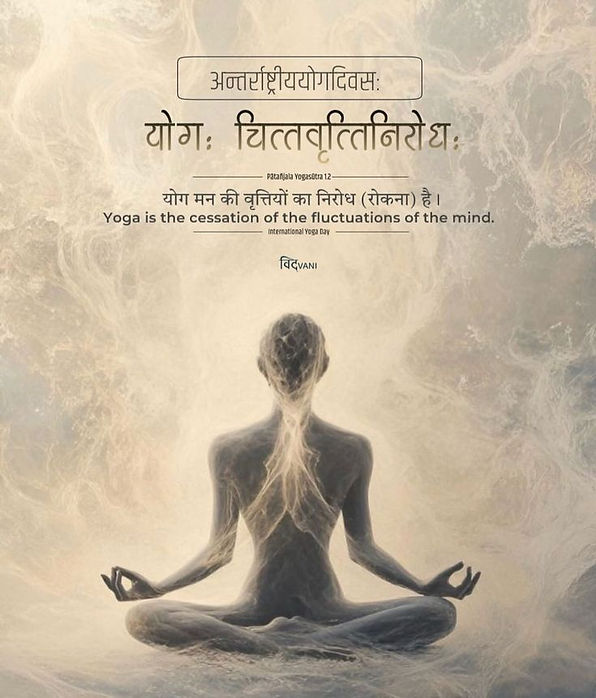
In the Yoga Sutra, the sage Patanjali describes Yoga as “the cessation of the fluctuations of the mind".
Patanjali summarized his teachings into the Patanjali Ashtanga Yoga (Patanjali Eight Limbs of Yoga), which serve as guidelines to reach the mastery of Yoga, eight elements of practice culminating in Samadhi.
The 8 Limbs are:
1. Yama (Restraints)
-
Ahimsa (Non-Aggression): Refers to non-violence & the prevention of violence, be it in the form of mental, physical or emotional.
-
Satya (Truthfulness): Authenticity (to self), and honesty (to others).
-
Asteya (Non-Stealing): Not taking whatever is belonging to another.
-
Brahmacharya (Sensory Control): Not indulging in the distraction of the 6 sensory functions to preserve spiritual energy.
-
Aparigraha (Non-Attachment): Non-attachment to mental fabrications or material objects.
2. Niyama (Observances)
-
Saucha (Purification):
-
Purification of mind: freeing the mind of negative thoughts & emotions.
-
Purification of speech & actions: Integrity, honesty & kindness.
-
Purification of intent: Acting with self-awareness, and without selfish motivations.
-
Purity of body: Maintaining personal hygiene.
-
Purity of sustenance: Consuming sattvic food, balanced & nutritious.
-
Purity of environment: Maintaining cleanliness of surroundings.
-
-
Santosha (Contentment): Refers to making the best of what you have, limiting material desires, and not coveting the possessions of others.
-
Tapas (Discipline): Refers to Yogic intense self-discipline and cultivation of will power.
-
Svadhyaya (Introspection): Refers to constantly studying your thoughts and emotions.
-
Isvara Pranidhana (Dedication): Refers to the mastery of the highest version of your self.
3. Asana (Posture): A physical posture in which one can be steady and comfortable.
4. Pranayama (Expansion of the Prana): Unlocking blocked meridians, and mastery of Prana
5. Pratyahara (Withdrawal Of The 6 Senses)
6. Dharana (One-Pointed Concentration)
7. Dhyana (Contemplative Meditation)
8. Samadhi (Spiritual Absorption)
The main aim of practice is Kaivalya, discernment of Purusha (the witness-consciousness) as distinct from Prakriti (the cognitive apparatus) and disentanglement of Purusha from Prakriti's muddled defilements.
SAMSKARA
Samskara are the mental conditioning, and impressions left by all thoughts, intentions and actions that an individual has ever experienced.
Samskara can be considered as psychological or emotional imprints that contribute to the formation of behavioral patterns. Samskara are in the unconscious mind, below the level of normal consciousness and are said to be the root of all impulses, character traits and innate dispositions.
VASANA
Vasana are the latent tendencies developed from Samskara (impressions) from the present and past lifetimes that fuel the cycle of birth & death (Samsara) until they are exhausted.
It is believed that it is stored in our Hidden (Sub)conscious, which explains why we might like/dislike someone or something without any reason, or tend to know of something when we have not done it before, or know of places that we have not been there in this lifetime. It also includes the memories, thoughts, feelings, and even habits and certain traits of our ancestors that is carried in our blood.
BUDDHI
Buddhi is derived from the Vedic Sanskrit root Budh, which literally means "to wake, be awake, observe, heed, attend, learn, become aware of, to know, be conscious again".
Buddhi refers to our "wisdom mind" - the intellectual faculty and the power to "form and retain concepts, reason, discern, judge, comprehend & understand".
The purpose of Yoga is to train our Buddhi to help us make the right choice as it is our inner wisdom.
MANAS
Manas refers to our "thinking mind" - the general thinking faculty, the conscious thinking via volition. It is the Manas that manifests intentions into thoughts, speech and actions.
The purpose of Yoga is to ensure that what we manifest in thought, speech & action are true & aligned with our true self.
CITTA
The Citta refers to our "emotional mind" - your likes & dislikes, agitation & phobia etc. It is our Citta that reacts to emotional triggers.
An untrained Citta is why your attention jumps from one object to another. Without a specified object to focus on, the Citta is restless and unstable, fluctuating like a waveform, arising and falling. The purpose of Yoga is to tame this "monkey mind", and achieve a state of equanimity.
AHAMKARA
In Yoga, Ahamkara is often translated as "ego" or "ego-consciousness", but it is actually more than that. It is the fabricated "false-identity", consisting of personal pride, opinions from people around you, societal expectations, status in society, position at work etc.
And because of all these factors, you are enslaved to your "false-identity".
The teachings of Yoga, Buddhism and Daoism is to dissolve this false sense of "self-identity".
SAMSKARA
Samskara are the mental fabrications and impressions left by all thoughts, intentions and actions that an individual has ever experienced.
Samskara can be considered as psychological or emotional imprints that contribute to the formation of behavioral patterns. Samskara are in the unconscious mind, below the level of normal consciousness and are said to be the root of all impulses, character traits and innate dispositions.
VASANA
Vasana are the latent tendencies developed from Samskara (impressions) from the present and past lifetimes that fuel the cycle of birth & death (Samsara) until they are exhausted.
It is believed that it is stored in our Hidden (Sub)conscious, which explains why we might like/dislike someone or something without any reason, or tend to know of something when we have not done it before, or know of places that we have not been there in this lifetime.
VRITTI
Patanjali’s Yoga Sutra categorizes Vritti into five types, each with its unique characteristics and effects on the mind.
-
Right Cognition (Pramana): It refers to the ability to perceive information correctly based on our beliefs, experiences, and moral values.
-
Misconception (Viparyaya): This vritti occurs when the mind incorrectly interprets sensory information.
-
Imagination (Vikalpa): This vritti represents the mind’s ability to create mental images, fantasies, and daydreams.
-
Sleep (Nidra): This vritti is more than just the absence of wakefulness. It’s an altered state of consciousness where the mind’s thought patterns are significantly reduced.
-
Memory (Smriti): Smriti, or “memory,” involves the recollection of past sensations or emotions, both conscious and unconscious.
PRAMANA
Within the realm of Pramana, the mind employs a diverse set of tools to determine the validity of information. These six types of Pramana Vritti are essential to our understanding of the world:
-
Direct Experience (Pratyaksha): This is the most straightforward form of Pramana, relying on sensory perception. What we see, hear, taste, touch, and smell directly informs our understanding of reality.
-
Inference (Anumana): Inference involves drawing conclusions based on observations. For example, if we see smoke, we infer the presence of fire.
-
Comparison (Upamana): Upamana Pramana relies on comparison. When we relate something new to something familiar, we gain insights. For instance, a new fruit is described as “like an apple.”
-
Postulation (Arthapatti): This form of Pramana helps us understand scenarios where direct evidence is lacking. For example, if a person never eats during the day but remains healthy, we postulate that they eat at night.
-
Non-apprehension (Anupalabdhi): Anupalabdhi is the perception of the absence of something. It’s the recognition that something we expected to see or experience is not present.
-
Verbal Testimony (Sabda): This involves gaining knowledge from credible sources, such as teachers, books, or experts. It’s an important Pramana as it enables us to access knowledge beyond our direct experiences.
VIPARYAYA
Viparyaya, often referred to as “misconception,” represents one of the five Vrittis that shape our mental landscape. This Vritti occurs when the mind incorrectly interprets sensory information, leading to a distortion of reality. In the intricate tapestry of the mind’s fluctuations, Viparyaya can be likened to a mirage, where what we perceive may not align with the truth.
VIKALPA
Vikalpa, often associated with imagination, is a fascinating Vritti that explores the creative depths of the mind. This mental fluctuation allows us to conjure mental images, fantasies, and daydreams. While imagination can be a wellspring of inspiration and innovation, it also has the potential to lead the mind astray if left unchecked. Uncontrolled imagination (Vikalpa) can be likened to a wandering mind lost in fantasy. It often leads to daydreaming, doubt, and indecision. While brief moments of wandering imagination can be harmless, unchecked Vikalpa Vritti can become a source of distraction and mental turmoil.
NIDRA
Nidra, the Vritti of sleep, introduces us to an altered state of consciousness that is both mysterious and profound. In the landscape of mental fluctuations, Nidra represents a unique state where the mind’s thought patterns are significantly reduced. It’s a state where we experience rest and restoration, but it’s not merely the absence of wakefulness. Nidra is akin to the moments just before falling asleep or those right upon waking. It’s a state where the mind’s usual chatter subsides, and we find ourselves in a realm where thoughts are minimal, if not absent. It’s a transient state that holds great potential for self-discovery and transformation. Quality sleep is essential for our overall well-being, both physically and mentally. Nidra not only allows the body to rejuvenate but also offers the mind a reprieve from the incessant thought waves of the waking state. It’s during these moments of rest that we find a sense of inner peace and balance. Patanjali recognized the significance of experiencing peace of mind during deep sleep. In Yoga Sutra (1.38), he emphasizes the value of studying dreams and deep sleep states as a means to stabilize the mind.
SMRITI
Smriti, often referred to as “memory,” is a Vritti that takes us on a journey through the corridors of our past. It involves the recollection of lasting impressions, both conscious and unconscious, that have been imprinted on the canvas of our mind by past sensations and emotions.
Think of Smriti as the mental archive that stores our life’s experiences, both significant and mundane. It encompasses memories of joy, sorrow, love, and countless other emotions, each with its unique vibrancy and texture. These memories shape our perception of the world and influence our responses to present situations.
People are often not living in the present, trapped in the illusions of the past (memories based off various emotions) or the future (fear, anxiety or worry).
To stop waves, we have to create waves, thus in the Yoga Sutras (1:5) there are five vritti hinderous and helpful.
These are:
-
Prāmana - literally "the measure of", it is the movement of thought when we experience something directly, or (by inference) infer what an experience is like, or we hear an account of what it is like that is not falsified when experienced.
-
Viparyaya - misapprehension of one thing for another, which is falsified when actually experienced.
-
Vikalpah - verbal abstraction or imagination without an objective experience
-
Nidrā - waking continuum from distraction to oblivion to full sleep without the support of cognition
-
Smrtayah - remembering both the material of experience and its cognition.